The JAECOO J7 price in Pakistan is PKR 99.99 lacs ex-factory. It returns about 13.5 km/l combined.
Prices are ex-factory and exclude freight, registration and withholding tax, so what you pay on the road is higher. Last checked 14 September 2026. See the full fuel average and monthly running cost ›
Premium, the only trim sold here. Reduced Rs 500,000 on 14 September 2026. Ex-factory and inclusive of all applicable taxes. Freight and transit insurance of Rs
| Variant | Ex-Factory Price |
|---|---|
| JAECOO J7 SHS PHEV Premium 1500 cc, 1-DHT, Plug-in hybrid Fifth-generation 1.5 TGDI dedicated hybrid engine with 1-DHT, Drive motor 150 kW and 310 Nm; system 255 kW (341 hp) and 525 Nm, 18.3 kWh battery; front-wheel drive, 90 km WLTP electric range; 1,200+ km WLTP combined, 6.0 L/100 km WLTP once the battery is flat, 0-100 km/h in 8.5 seconds Premium, the only trim sold here. Reduced Rs 500,000 on 14 September 2026. Ex-factory and inclusive of all applicable taxes. Freight and transit insurance of Rs | PKR 9,999,000 |
The J7 SHS is the most sensible thing NexGen sells and, since the September price cut, one of the better-value electrified cars in Pakistan. A plug-in hybrid answers the Pakistani electric-car problem more neatly than a battery car does. 90 km of WLTP electric range covers the daily driving of almost everyone who owns a PKR 1 crore SUV, so most running happens on electricity charged at home overnight. When you want to drive to another city, the engine takes over and you stop at a petrol pump like anyone else - 1,200 km of combined range, no planning, no app, no queue. Very few cars sold here work properly under both conditions. What comes with it is unusually complete for the money: 341 hp, a 14.8-inch screen and head-up display, a Sony system, heated and ventilated front seats with memory, a 540-degree camera, a full driver-assistance package including traffic jam assist and driver monitoring, and a 3.3 kW vehicle-to-load outlet that will run a house through load-shedding. Seven airbags is a good count at this price, even if it is one short of what the website claims. The reservations are modest. It is front-wheel drive, which the styling rather implies otherwise, and 174 mm of ground clearance is unremarkable. The 19-inch wheels are exposed on poor roads. And a plug-in hybrid is mechanically the most complex option here - engine, motor, battery and hybrid transmission all to maintain - which is a real consideration against a brand whose service record in Pakistan is still only a year old.
25 photos · 19 exterior, 6 interior · JAECOO / NexGen Auto Pakistan
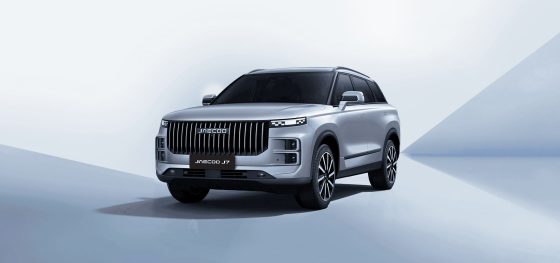
The JAECOO J7 SHS is the brand's plug-in hybrid and its most powerful car in Pakistan, sold in a single Premium specification at PKR 99,99,000 ex-factory. NexGen cut that by Rs 500,000 on 14 September 2026.
The powertrain pairs a fifth-generation 1.5 TGDI dedicated hybrid engine with a 150 kW drive motor through a single-speed dedicated hybrid transmission, for a combined 255 kW - JAECOO quotes 341 hp - and 525 Nm. An 18.3 kWh battery gives 90 km of WLTP electric range, and with the 60-litre tank the combined figure is 1,200+ km. 0-100 km/h takes 8.5 seconds. Drive is to the front wheels.
The useful part of a plug-in hybrid in Pakistan is that 90 km covers most people's daily driving on electricity, while the engine removes any dependence on the charging network for longer trips. JAECOO quotes 6.0 L/100 km on WLTP once the battery is flat.
It is 4,500 mm long, 1,865 wide and 1,670 tall on a 2,672 mm wheelbase with 174 mm of ground clearance, on 19-inch wheels with Kumho tyres.
Equipment is the most complete JAECOO sells here: seven airbags, a 14.8-inch screen with a 10.25-inch cluster and a head-up display, an eight-speaker Sony system, a 540-degree camera, heated and ventilated front seats with driver memory, a panoramic skylight, an induction tailgate, a centre armrest cool box, and 3.3 kW vehicle-to-load.
On the price: NexGen's figures are ex-factory and inclusive of all applicable taxes, with Rs 55,000 per unit added for freight and transit insurance. Booking takes a pay order or bank draft in favour of NexGen Auto Pvt Ltd with a minimum advance of 20 per cent, the balance falls due at least a month before delivery, and delivery is first-come, first-served.
One caution if you are comparing prices elsewhere: NexGen's own downloadable price lists are out of date. The J5 sheet still shows the pre-October figures and the J7 sheet predates its September price cut. The prices on this page are the announced current ones.
The J7 SHS is a plug-in hybrid, which means the battery is large enough to drive on alone for a useful distance and the car has a charging port - unlike the J5, whose 1.83 kWh pack is only a buffer. The engine is a fifth-generation 1.5 TGDI dedicated hybrid unit working through a single-speed dedicated hybrid transmission that JAECOO calls 1-DHT. The drive motor contributes 150 kW and 310 Nm on its own; combined system output is 255 kW - JAECOO quotes 341 hp - and 525 Nm. Drive is to the front wheels only, with Normal, Eco and Sport modes, and the engine meets Euro 6B. The battery is 18.3 kWh, giving 90 km of pure-electric range on WLTP. The combined figure is 1,200+ km WLTP with the 60-litre tank, and JAECOO quotes 6.0 L/100 km once the battery is depleted and the engine is doing the work. That last figure is the one to plan around on a long trip. The 1,200 km headline assumes you set off with a full battery, which you will not have again until you stop and charge; after the first 90 km the J7 is a petrol car carrying a battery. Vehicle-to-load is rated at 3.3 kW, which will run a fridge, fans and lights through a long load-shedding spell. Suspension is MacPherson struts at the front and a multi-link rear, with ventilated front discs, on 19-inch wheels wearing Kumho tyres. Ground clearance is 174 mm - slightly less than the smaller J5's 176 mm, which is worth noting if you had assumed the bigger car sits higher.
The J7 has two consumption figures and they describe different cars. With a charged battery it runs as an electric car for 90 km on WLTP, using no petrol at all. For an owner who charges at home nightly and drives less than that in a day, the running cost is an electricity bill and the tank lasts months. Once the battery is flat the engine takes over and JAECOO quotes 6.0 L/100 km on WLTP - about 16.7 km/l. This site works on roughly 85 per cent of a WLTP claim for Pakistani conditions, which puts the real charge-sustaining figure nearer 14 km/l. The detailed figures on this page are that condition: battery flat, engine working. They are not a JAECOO claim and they are not a Pakistani measurement, but they are the numbers to plan a long trip around. The 90 km electric range should also be discounted for Pakistani conditions - expect nearer 76 km on WLTP calibration, and less in heavy summer air conditioning. The practical conclusion is simple. If you can charge at home, the J7 is a very cheap car to run day to day and a normal petrol SUV on the occasional long trip, which is close to the ideal arrangement for Pakistan. If you cannot charge at home, you are paying for an 18.3 kWh battery and a hybrid transmission you will never use properly, and carrying their weight - at which point the J5 at Rs 20 lac less is the more sensible car.
Open any variant above for its full specification sheet.
NexGen's J7 page says: "A complete suite of 8 airbags including front, side, curtain, seat gap, front center, and driver's knee airbags provides all round safety."
Their own price list itemises the J7's airbags as Dual Front Airbags, Front Side Airbags, Side Curtain Airbags and Driver's Knee Airbag. That is seven, and there is no centre or seat-gap airbag on the list.
Seven is what this site publishes, because the price list is the itemised equipment document and the model page is marketing copy. If a front centre airbag matters to your decision, ask the dealer to confirm it in writing before booking.
Seven is a good count at this price regardless, and the driver's knee airbag is uncommon in the segment.
The assistance package is the most complete NexGen publishes: adaptive cruise control, traffic jam assist, forward collision warning with autonomous emergency braking, lane departure prevention, emergency lane keeping, blind spot detection, rear cross traffic alert, and a driver monitoring system that tracks attentiveness.
Underneath: electronic stability program, anti-lock brakes with brake assist and brake override, electronic brakeforce distribution, tyre-pressure monitoring, ISOFIX anchors, driver and passenger seatbelt reminders, front and rear radars, a 540-degree HD panoramic camera, a built-in driving recorder, an engine immobiliser, a body anti-theft alarm and speed-sensing door locks.
The body is built with 80 per cent high-strength steel, which NexGen states on the model page.
No crash-test rating is published for the J7 by any programme. Pakistan has no NCAP of its own, so no car sold here carries an independent local crash rating.
PKR 99,99,000 ex-factory and inclusive of applicable taxes, in a single SHS PHEV Premium specification. NexGen cut it by Rs 500,000 on 14 September 2026. Rs 55,000 per unit is added for freight and transit insurance. Listings showing PKR 1,04,99,000 are quoting the pre-cut price.
Seven - dual front, front side, side curtain and a driver's knee airbag, per NexGen's own price list. The model page claims eight by adding a centre or seat-gap airbag, which the price list does not itemise.
90 km on WLTP from an 18.3 kWh battery, with 1,200+ km combined. In Pakistani conditions expect nearer 76 km of electric range, which still covers most people's daily driving.
No, but it is much cheaper to run if you do. It will work indefinitely on petrol alone, using about 6.0 L/100 km on WLTP once the battery is flat. Charging at home nightly means most of your driving happens on electricity.
No. It is front-wheel drive, despite the rugged styling. Ground clearance is 174 mm.
With a flat battery JAECOO quotes 6.0 L/100 km on WLTP, about 16.7 km/l; in Pakistani conditions expect nearer 14 km/l. With a charged battery and a daily drive under 90 km you may use almost no petrol at all.
The J7 is Rs 20 lac dearer and worth it only if you can charge at home. With home charging it runs on electricity most days, makes 341 hp against 221, and is far better equipped. Without home charging you are carrying an 18.3 kWh battery you never use, and the J5's self-charging hybrid is the more sensible car.
Six years or 150,000 km on the vehicle and eight years or 160,000 km on the battery, whichever comes first, published on NexGen's brochure.
Yes, 3.3 kW, enough to run a fridge, fans and lights through a long load-shedding spell.
The H6 PHEV starts at PKR 1,08,49,000 against the J7's PKR 99,99,000. The J7 is cheaper, has seven airbags and a longer published battery warranty. Haval has been assembled here by Sazgar since 2021 with a deeper service network and a resale record, which against a brand a year old is a real argument.