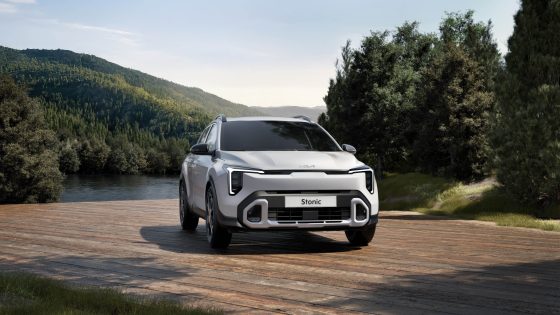
The international Stonic is the same shell as Pakistan's with a materially different drivetrain and cabin. Europe and Australia both get Kia's 48V mild hybrid, worth 15 to 20 PS and a measurable gain in exactly the low-speed phase where Pakistani traffic lives; Pakistan gets the plain 100 PS engine. Europe's top trim adds a 12.3-inch digital cluster, heated seats and steering wheel, a Digital Key and a sunroof, and - the real gap - an Advanced Driving Assistance Pack with autonomous emergency braking and lane keeping that lifted the car from three Euro NCAP stars to five. No Pakistani Stonic offers any of it.
15 photos · 10 exterior, 5 interior · Kia Europe press office
Each market tests to its own legal cycle, so these numbers describe the same engine measured three different ways. Read down a market, not across them. Figures are shown in km/l, with the market's own published unit beneath it wherever that unit differs.
| Variant | City | Highway | Combined | CO2 | Notes |
|---|---|---|---|---|---|
| 1.0 T-GDi 100 PS, 6-speed manual 100 PS · 172 Nm · 6-speed manual · Petrol | — | — | 16.9 5.9 l/100km | 133 g/km | The entry engine in Britain and much of Europe, and the closest thing abroad to Pakistan's 1.0 Turbo: same 998 cc, same 100 PS, no mild hybrid. Europe pairs it with a six-speed manual; Pakistan does not offer a manual on this engine at all. Certified on Europe's WLTP cycle, which is measured in a laboratory on a rolling road. It is more realistic than the old NEDC test it replaced, but it is still a lab figure, and Pakistani traffic, fuel and heat will not reproduce it. Source |
| 1.0 T-GDi 100 PS, 7-speed DCT 100 PS · 172 Nm · 7-speed DCT · Petrol | 13 7.7 l/100km | 20.4 4.9 l/100km | 17.2 5.8 l/100km | 131 g/km | Mechanically the same car Pakistan gets as the Stonic 1.0 Turbo: 998 cc, 100 PS, 172 Nm, seven-speed dual-clutch, no electrification. The city and highway figures above are WLTP's own low-speed and high-speed phases, so they show how far apart traffic and motorway running are even in a laboratory: 13.0 against 20.4 km/l. Certified on Europe's WLTP cycle, which is measured in a laboratory on a rolling road. It is more realistic than the old NEDC test it replaced, but it is still a lab figure, and Pakistani traffic, fuel and heat will not reproduce it. Source |
| 1.0 T-GDi 115 PS 48V mild hybrid, 6-speed iMT 115 PS · 172 Nm · 6-speed iMT · Mild hybrid | 13.7 7.3 l/100km | 20.4 4.9 l/100km | 17.5 5.7 l/100km | 129 g/km | Kia's 48V mild hybrid adds a belt-driven starter-generator that restarts the engine and fills in low-rpm torque, and an iMT gearbox with a clutch-by-wire that lets the engine shut off while the car coasts. It is worth 15 PS and about 5 per cent in the low-speed phase over the plain 100 PS DCT - the gain lands in traffic, which is exactly where Pakistan would want it. Not offered here. Certified on Europe's WLTP cycle, which is measured in a laboratory on a rolling road. It is more realistic than the old NEDC test it replaced, but it is still a lab figure, and Pakistani traffic, fuel and heat will not reproduce it. Source |
| 1.0 T-GDi 115 PS 48V mild hybrid, 7-speed DCT 115 PS · 172 Nm · 7-speed DCT · Mild hybrid | — | — | 17.9 5.6 l/100km | 127 g/km | The most efficient Stonic sold anywhere, and the version the 2026 facelift leads with in Europe. 0-100 km/h in 10.8 seconds against 12.1 for the 100 PS DCT, on less fuel. Certified on Europe's WLTP cycle, which is measured in a laboratory on a rolling road. It is more realistic than the old NEDC test it replaced, but it is still a lab figure, and Pakistani traffic, fuel and heat will not reproduce it. Source |
| Variant | City | Highway | Combined | CO2 | Notes |
|---|---|---|---|---|---|
| 1.0T 88 kW 48V mild hybrid, 7-speed DCT (S / Sport / GT-Line) 120 PS · 172 Nm · 7-speed DCT · Mild hybrid | 17.2 5.8 l/100km | 22.2 4.5 l/100km | 20 5.0 l/100km | 116 g/km | Australia gets one powertrain across all three trims - 88 kW, which is 120 PS, with the 48V mild hybrid - so the S on 16-inch wheels and the GT-Line on 17s carry the same certified figure. On a 45-litre tank that combined number works out to roughly 900 km between fills. Certified to ADR 81/02, Australia's mandatory fuel-labelling standard. It weights the extra-urban phase more heavily than Europe's cycle does, which is why the same engine posts a better number here than in Europe. Source |
| Variant | City | Highway | Combined | CO2 | Notes |
|---|---|---|---|---|---|
| 1.0 T-GDi 120 PS, 7-speed DCT 120 PS · 172 Nm · 7-speed DCT · Petrol | — | — | 17 | — | The only Stonic anywhere to make 120 PS without a mild hybrid: Korea ran the 998 cc T-GDi at a higher state of tune, 120 PS against the 100 PS Europe and Pakistan get from the same block. Sold in the Stonic's home market from July 2017 and withdrawn in September 2020. Korea's certified combined figure, from when the Stonic was sold in its home market between July 2017 and September 2020. It was withdrawn there and has not returned, so this is a historical figure, not a current one. Source |
Europe and Australia certify in litres per 100 km; the km/l figure above it is our conversion, at 100 ÷ l per 100 km. Korea certifies in km/l, so those rows carry the published figure alone and no converted one.
What the international specification genuinely gains, and what it does not.
The Stonic sold outside Pakistan is the same body on the same 2,580 mm wheelbase, built on the same platform, and from October 2026 it shares Pakistan's 998 cc three-cylinder turbo. Almost everything else about it differs, and the differences are not trim-level garnish - they are the engine, the gearbox options, the instruments and the entire driver-assistance package.
Europe is the Stonic's main market and the one that got the 2026 facelift first. It offers four powertrains from the same 998 cc block: 100 PS with a six-speed manual, 100 PS with the seven-speed dual-clutch, and two 115 PS versions carrying Kia's 48V mild-hybrid system, one with a clutch-by-wire iMT manual and one with the dual-clutch. Britain sells three trims - Pure from GBP 22,195, GT-Line from GBP 24,795 and GT-Line S from GBP 28,495 - and the top car gets a 12.3-inch digital driver's display, heated front seats, a heated steering wheel, a wireless charger, a Digital Key and a tilt-and-slide sunroof.
Australia took the facelift in November 2025 with a single powertrain across all three trims: 88 kW, which is 120 PS, with the 48V mild hybrid and the dual-clutch. Its S starts at AUD 31,847 drive-away and the GT-Line at AUD 39,634.
Korea, where the Stonic was designed and where it launched in July 2017, no longer sells it. It was withdrawn in September 2020. It is included here because it is the only market that ever ran this engine at 120 PS without electrification.
Every international Stonic uses the same 998 cc Smartstream three-cylinder turbo petrol block as Pakistan's, in four states of tune.
In Europe the plain petrol version makes 100 PS at 6,000 rpm and 172 Nm from 1,500 rpm - identical to the Pakistani figures - with either a six-speed manual or the seven-speed dual-clutch. The mild-hybrid version makes 115 PS from the same block with the same 172 Nm, adding a 48V belt-driven starter-generator and lithium-ion pack; it comes with either the iMT, a six-speed manual whose clutch is actuated electronically so the engine can shut down while coasting, or the dual-clutch. Kia quotes 10.7 seconds to 100 km/h for the 115 PS iMT and 10.8 for the DCT, against 12.1 for the 100 PS dual-clutch. All of them are Euro 6e bis and run a 45-litre tank.
Australia's 2026 car is rated in kilowatts: 88 kW at 6,000 rpm, which is 120 PS, and 172 Nm from 1,500 to 4,000 rpm, with the 48V system and the dual-clutch only. No manual is offered.
Korea's car, sold from 2017 to 2020, ran the same block at 120 PS with the seven-speed dual-clutch and no electrification - the only market ever to do so. Korea also sold a 1,368 cc petrol and, for 2018 and 2019, a 1.6-litre diesel.
Three markets, three legal test cycles, and no honest way to compare the resulting numbers directly.
Europe certifies on WLTP. The 100 PS dual-clutch returns 5.8 l/100 km combined, which is 17.2 km/l, and its phase breakdown is the single most useful thing on this page: 7.7 l/100 km in the low-speed phase against 4.9 in the high-speed phase, or 13.0 against 20.4 km/l. That is a laboratory saying what every driver already knows - this engine's consumption is dominated by whether it is moving. The 115 PS mild hybrid improves the low-speed phase to 7.3 l/100 km and the combined figure to 5.7, and the mild-hybrid dual-clutch reaches 5.6 l/100 km, or 17.9 km/l, the best figure any Stonic has ever been certified at.
Australia certifies to ADR 81/02, which weights the extra-urban phase more heavily. Its 88 kW mild hybrid is rated 5.8 l/100 km urban, 4.5 extra-urban and 5.0 combined - 17.2, 22.2 and 20.0 km/l. That 20.0 is the highest number attached to any Stonic anywhere, and it is a function of the test as much as the car.
Korea's certified combined figure for the 120 PS car was 17.0 km/l on its own domestic cycle.
None of these is a Pakistani figure and none of them should be quoted as one. Pakistan has no mandatory fuel-economy test, Kia Pakistan publishes no figure for the Stonic, and the Pakistani car has neither the mild hybrid nor the manual gearboxes that produce several of the numbers above. Our Pakistani page carries projections built from owner data in comparable conditions, and says so.
Euro NCAP crash-tested the Stonic in December 2017 and published two results for the same car.
In standard specification it scored three stars: 85 per cent adult occupant protection, 84 per cent child occupant, 62 per cent for vulnerable road users and 25 per cent for safety assist. Fitted with Kia's optional Advanced Driving Assistance Pack it scored five stars: 93 per cent adult occupant, 84 per cent child occupant, 71 per cent for vulnerable road users and 59 per cent for safety assist.
The pattern is worth reading carefully. The structure did not change between the two tests - the pack adds autonomous emergency braking and lane keeping, which is what lifts safety assist from 25 to 59 per cent, improves the pedestrian score through automatic braking, and pulls the adult score up by preventing the impact rather than surviving it. The same body shell earns three stars or five depending entirely on whether that equipment is fitted.
That is directly relevant to Pakistan, where no Stonic offers autonomous emergency braking, lane keeping, blind-spot monitoring or adaptive cruise control on any trim. The Pakistani car has six airbags, stability control and ISOFIX, which is a respectable passive package - but it is the three-star specification, not the five-star one, and it has never been crash-tested in any form because Pakistan has no NCAP programme.
Two further cautions. Euro NCAP's Stonic rating expired in January 2024 and is no longer listed as current, because the protocol has moved on. And Australia's five ANCAP stars for the Stonic were transferred from crash tests of the Rio hatchback rather than the Stonic itself, under a rule that has since been closed.
The same body, platform and 2,580 mm wheelbase, and from October 2026 the same 998 cc turbo block. The drivetrain and the equipment are not the same. Europe and Australia both get Kia's 48V mild hybrid at 115 to 120 PS; Pakistan gets 100 PS with no electrification. Europe offers two manual gearboxes; Pakistan offers none. And Europe's cars can be had with an Advanced Driving Assistance Pack that no Pakistani Stonic offers on any trim.
The European 115 PS mild hybrid with the seven-speed dual-clutch, at 5.6 l/100 km combined on WLTP, which is 17.9 km/l. Australia's 88 kW mild hybrid shows a higher number, 5.0 l/100 km or 20.0 km/l, but that is measured on ADR 81/02, a different and gentler cycle, so the two are not comparable.
No, and that is the reason this section is separate. Several of these numbers come from a mild hybrid Pakistan does not get, two come from manual gearboxes Pakistan does not get, and all of them are laboratory results from cycles that do not reproduce Pakistani traffic, heat or fuel. Our Pakistani page carries projections built from owner data in comparable conditions and labels them as projections.
A belt-driven starter-generator and a small lithium-ion pack that restart the engine smoothly, recover energy under braking and add torque at low rpm. It cannot drive the car on electricity. Its benefit is concentrated in stop-start running, which is exactly where Pakistani fuel consumption is worst - the European figures show it improving the low-speed phase from 7.7 to 7.3 l/100 km while adding 15 PS. It is not offered in Pakistan.
Euro NCAP tested it in December 2017 and gave it three stars in standard form - 85 per cent adult occupant, 84 per cent child occupant - and five stars with the Advanced Driving Assistance Pack, which raised adult protection to 93 per cent and safety assist from 25 to 59 per cent. That rating expired in January 2024. The Pakistani car corresponds to the three-star specification and has never been independently crash-tested, because Pakistan has no testing programme.
No. It launched in its home market in July 2017 and was withdrawn in September 2020. Korea's car was the only Stonic to make 120 PS from this engine without a mild hybrid, and its certified combined figure was 17.0 km/l.
Because duty, excise, sales tax and registration differ so completely between these markets that a converted number would mislead rather than inform. Australia's AUD 31,847 for the base S is a drive-away price including on-road costs; Pakistan's PKR 54.99 lacs is ex-factory before withholding tax, freight and insurance. They are not the same kind of figure, and an exchange rate would put a false precision on the comparison.
Photographs: Kia Europe press office. Shown here because they depict the international car; the Pakistani page uses photographs of the Pakistani specification.
Manufacturer reference: https://www.kia.com/uk/new-cars/stonic/