The Kia Stonic price in Pakistan is PKR 54.99 - 58.99 lacs ex-factory, across 2 variants. It returns about 13.7 to 14 km/l combined.
Prices are ex-factory and exclude freight, registration and withholding tax, so what you pay on the road is higher. Last checked 1 October 2026. See the full fuel average and monthly running cost ›
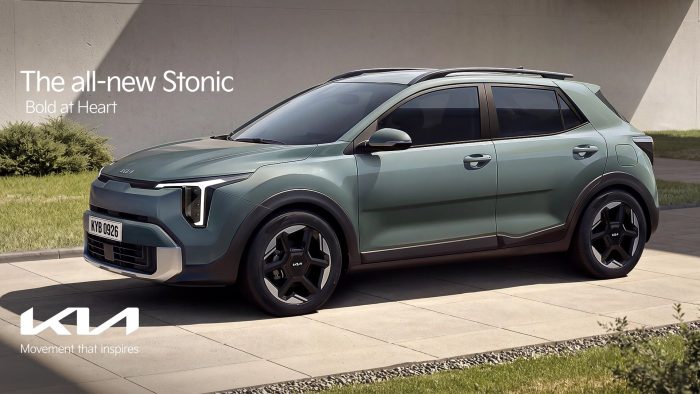
The price of the Kia Stonic in Pakistan ranges from PKR 5,499,000 for the base Turbo X to PKR 5,899,000 for the top of the line Turbo S. These are ex-factory prices.
| Variant | Ex-Factory Price |
|---|---|
| Kia Stonic Turbo XBase 998 cc, 7-speed DCT, Petrol Launched 1 Oct 2026. Deliveries from Nov 2026. | PKR 5,499,000 |
| Kia Stonic Turbo STop of the line 998 cc, 7-speed DCT, Petrol Launched 1 Oct 2026. Deliveries from Nov 2026. | PKR 5,899,000 |
13 photos · 9 exterior, 4 interior · Kia Lucky Motor Corporation, Kia international press
The Kia Stonic is assembled in Pakistan by Kia Lucky Motors at Bin Qasim, Karachi, the joint venture between Kia and the Yunus Brothers Group that returned the brand to Pakistan in 2017. The Stonic sits at the entry point of Kia's local range, below the Sportage and Sorento.
The car on sale today is the all-new generation, launched on 1 October 2026 in two trims: Turbo X at PKR 54.99 lacs and Turbo S at PKR 58.99 lacs. It replaces the 1.4-litre EX and EX+ that Kia had built here since late 2021, and it is not an addition to that range - the naturally aspirated car has been discontinued.
The change underneath is substantial. Where the old Stonic used a 1,368 cc naturally aspirated four with a six-speed torque-converter automatic, the new one runs a 998 cc three-cylinder turbo with direct injection and a seven-speed dual-clutch gearbox. Peak power is unchanged at 100 PS, but torque rises from 133 Nm at 4,000 rpm to 172 Nm from just 1,500 rpm - which is the difference most owners will actually feel.
The pricing is the surprise. The new Turbo S undercuts the outgoing EX+ by PKR 1 lac, and the base Turbo X arrives PKR 5 lacs below it while gaining cruise control, a reversing camera, parking sensors and six airbags as standard. At PKR 54.99 lacs it is currently the cheapest turbocharged, dual-clutch, six-airbag crossover on sale in Pakistan.
Both Pakistani trims use the same powertrain: a 998 cc Smartstream turbocharged three-cylinder petrol engine with direct injection, rated at 100 PS at 6,000 rpm and 172 Nm from 1,500 to 3,500 rpm, driving the front wheels through a seven-speed dual-clutch transmission. Compression is 11.5:1 and Kia specifies regular unleaded at a minimum of 92 RON. Top speed is 179 km/h and the tank holds 45 litres. There is no manual, no hybrid and no all-wheel-drive option. The outgoing car used a 1,368 cc naturally aspirated four with a six-speed torque-converter automatic, so the change is a genuine one - more torque, delivered far lower, through a very different gearbox.
The Kia Stonic fuel average in Pakistan is 11.8 to 12 km/l in the city and 16.2 to 16.5 km/l on the highway, or about 13.7 to 14 km/l combined, across the two 1.0 Turbo variants on sale. Everything below explains why those are projections rather than measurements, and what they are built from. Kia Pakistan publishes no fuel-economy figure for the Stonic, for either the new 1.0 Turbo or the old 1.4. The 13 city and 16 highway km/l figure in circulation is an aggregator's own editorial estimate rather than a manufacturer claim - and that site now prints it against the 998 cc turbo variants, which have no owners at all. For the outgoing 1.4 there is real data. Across thirty Pakistani owner reviews, twelve recorded structured city and highway figures: the city numbers average 12.6 km/l with a median of 13 and a range of 9 to 14, and the highway numbers average 15.4 with a median of 16 and a range of 13 to 17. Owners rated fuel economy 4.5 out of 5. The spread matters more than the average. Two owners reporting from the car's own trip computer recorded 9 to 9.5 km/l in bumper-to-bumper Karachi and Islamabad traffic, while steady motorway running at 60 to 115 km/h produced 16 to 20. Sustained speeds above 130 km/h pull it back to around 14, and one owner put the air-conditioning cost at 2 to 4 km/l. For the new 1.0 Turbo there is no data at all. Deliveries begin in November 2026, so nobody has driven one far enough to report. A smaller turbocharged engine with a dual-clutch typically beats a larger naturally aspirated one on a steady motorway run and can do worse in heavy urban traffic, but that is an engineering expectation and not a measurement.
Open any variant above for its full specification sheet.