The Hyundai IONIQ 6 price in Pakistan is PKR 2.3 - 2.4 crore ex-factory, across 2 variants. It claims up to 519 km of electric range.
Prices are ex-factory and exclude freight, registration and withholding tax, so what you pay on the road is higher.
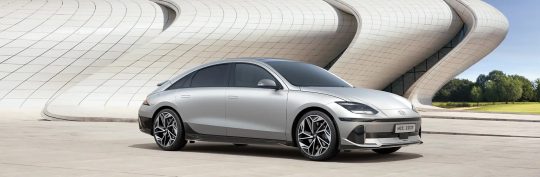
The price of the Hyundai IONIQ 6 in Pakistan ranges from PKR 23,000,000 for the base Smart to PKR 24,000,000 for the top of the line Signature. These are ex-factory prices.
| Variant | Ex-Factory Price |
|---|---|
| Hyundai IONIQ 6 SmartBase 1-speed reduction gear, Electric The Signature is PKR 24,000,000. | PKR 23,000,000 |
| Hyundai IONIQ 6 SignatureTop of the line 1-speed reduction gear, Electric The Smart is PKR 23,000,000. | PKR 24,000,000 |
A 77.4 kWh battery that goes further than the IONIQ 5's 84 kWh is the clearest demonstration available in a Pakistani showroom that shape beats capacity. If efficiency is what you are buying, this is the Hyundai to buy, and at PKR 230.00 lacs it costs PKR 5 lacs more than an IONIQ 5 Smart for materially better range. The caveat is documentation rather than the car: Hyundai Nishat publishes nothing for the IONIQ 6 - no brochure, no spec sheet, no charging times, no equipment list. Every figure except the price comes from launch coverage. Insist on a written specification and a written battery warranty before you sign, because the four-year battery term on Hyundai's own IONIQ price list is half what the market normally offers.
14 photos · 8 exterior, 6 interior · Hyundai Nishat Motor (Private) Limited
The IONIQ 6 is Hyundai's electric fastback sedan, sold in Pakistan in Smart and Signature trims at PKR 2,30,00,000 and PKR 2,40,00,000.
It is the most aerodynamically efficient car Hyundai sells here, and that shows in the numbers: a 77.4 kWh battery - smaller than the IONIQ 5's 84 kWh - returns a longer range, up to 519 km, because a low fastback sedan slips through the air far better than a tall crossover does. On those figures it is the most efficient car in Hyundai's Pakistani range by a clear margin.
The powertrain is a twin-motor all-wheel-drive setup producing 239 kW - 325 ps - and 605 Nm, the same output as the IONIQ 5, through a single-speed reduction gear. The body is 4,855 mm long, 1,880 wide and 1,495 tall on a 2,950 mm wheelbase, seating five.
One thing must be said plainly. Hyundai Nishat publishes no brochure and no specification sheet for the IONIQ 6. Its own specification page returns only the body type - mid-size fastback sedan - and the seat count, and there is no e-brochure link anywhere on the model page. The price, body type and seats here are Hyundai's. The battery, range, motor and dimension figures are the global Long Range all-wheel-drive specification as reported at the Pakistani launch, and should be treated as indicative until Hyundai publishes a local sheet.
SOURCING NOTE FIRST: Hyundai Nishat publishes no specification sheet or brochure for the IONIQ 6 in Pakistan. What follows is the global Long Range all-wheel-drive specification as reported at the Pakistani launch, not figures Hyundai Pakistan has published. Twin permanent-magnet synchronous motors produce a combined 239 kW - 325 ps - and 605 Nm, driving all four wheels through a single-speed reduction gear. That is the same output as the IONIQ 5, in a lighter and far more aerodynamic body. The battery is a 77.4 kWh lithium-ion pack, 6.6 kWh smaller than the IONIQ 5's, and it returns a longer range: up to 519 km against 500. The reason is drag. A fastback sedan 1,495 mm tall presents a much smaller and cleaner frontal area than a 1,605 mm crossover, and at motorway speeds aerodynamic drag is the dominant drain on an electric car's battery. The car is built on Hyundai's E-GMP platform - the same architecture as the IONIQ 5 - measuring 4,855 mm long on a 2,950 mm wheelbase.
An electric car has no fuel average, so the figures here are consumption and range. At 77.4 kWh and up to 519 km, consumption works out to about 14.9 kWh per 100 km. That is a gross figure against total battery capacity, so real consumption will be higher - but it is the best in Hyundai's Pakistani range, and comfortably better than the IONIQ 5's 16.8 on the same basis. The comparison between the two IONIQs is the most instructive thing on this page. The IONIQ 6 carries 8 per cent less battery and travels 4 per cent further. All of that difference is shape: same platform, same motors, same power, 110 mm lower roof. In Pakistani summer conditions with air conditioning running continuously, plan on around 85 per cent of the published figure - roughly 440 km. Sustained motorway speed will reduce it further, though less sharply than it would in the taller IONIQ 5, because the drag penalty rises with the square of speed and this car starts from a lower base. Hyundai publishes no charging times for the Pakistani car, so none are quoted here.
Open any variant above for its full specification sheet.
This section is shorter than it should be, and that is the point.
Hyundai Nishat publishes no specification sheet, no brochure and no equipment list for the IONIQ 6 in Pakistan. Its own specification page returns the body type and the seat count and nothing else. There is no published airbag count, no published driver-assistance list and no published charging information.
This site will not fill that gap with figures from other markets. The IONIQ 6 is well equipped elsewhere, but what Hyundai Nishat actually fits to the Pakistani car is not documented publicly, and assuming otherwise would be guesswork presented as fact.
What can be said: it is built on Hyundai's E-GMP platform, which places the battery in the floor between the axles for a low centre of gravity and leaves a large crash structure ahead of the cabin.
Before buying, ask the dealer for a written specification covering the airbag count, the driver-assistance equipment, the DC and AC charging times, and the drive-battery warranty term. Hyundai's own IONIQ price list shows four years on the battery, which is half what most manufacturers offer.
Pakistan has no NCAP programme, so the car sold here carries no independent crash rating.
The Smart is PKR 2,30,00,000 and the Signature is PKR 2,40,00,000, both ex-factory, from Hyundai's own price list.
Up to 519 km from a 77.4 kWh battery. Note that Hyundai Nishat publishes no specification sheet for this car - that figure comes from launch coverage, not from Hyundai Pakistan.
Aerodynamics. The IONIQ 6 is a fastback sedan 1,495 mm tall against the IONIQ 5 crossover's 1,605 mm, on the same platform with the same motors. At speed, drag is the dominant drain on an electric car's battery, so the lower, cleaner shape travels further on 6.6 kWh less.
On the published figures, yes - about 14.9 kWh per 100 km against the IONIQ 5's 16.8.
239 kW - 325 ps - and 605 Nm from twin motors with all-wheel drive, the same output as the IONIQ 5.
No. There is no brochure and no specification sheet, and Hyundai's own specification page returns only the body type and seat count. The battery, range, motor and dimension figures reported here come from launch coverage. Ask the dealer for a written specification before buying.
Hyundai's IONIQ price list shows 4 years, which is half the 8 years most manufacturers offer on an electric car's drive battery. Confirm it in writing.
The IONIQ 6 has better range and efficiency for PKR 5 lacs more. The IONIQ 5 has a 3,000 mm wheelbase, a 745-litre boot, a far more practical crossover body, and - critically - Hyundai actually publishes a specification sheet for it.