The Kia EV5 price in Pakistan is PKR 1.69 - 2.19 crore ex-factory, across 2 variants. It claims up to 500 km of electric range.
Prices are ex-factory and exclude freight, registration and withholding tax, so what you pay on the road is higher.
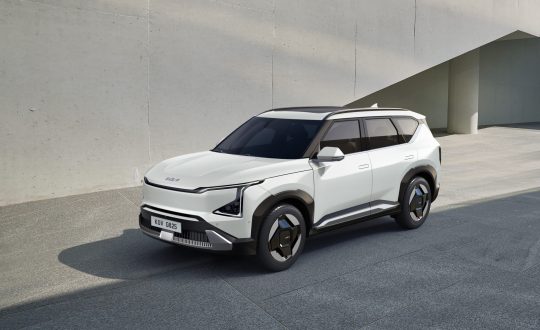
The price of the Kia EV5 in Pakistan ranges from PKR 16,850,000 for the base Air to PKR 21,850,000 for the top of the line Earth. These are ex-factory prices.
| Variant | Ex-Factory Price |
|---|---|
| Kia EV5 AirBase 1-speed, Electric 160 kW and 310 Nm, front motor, two-wheel drive, 0-100 km/h in 8.5 seconds; 185 km/h, 64.2 kWh lithium iron phosphate battery, 400 km WLTP range (490 km NEDC), Vehicle-to-load interior socket, i-Pedal one-pedal driving Limited-time price from 7 Sep 2026. Was PKR 18,500,000. | PKR 16,850,000 |
| Kia EV5 EarthTop of the line 1-speed, Electric 230 kW and 480 Nm combined - 160 kW front, 70 kW rear - all-wheel drive, 0-100 km/h in 6.1 seconds; 185 km/h, 88.1 kWh lithium iron phosphate battery, 500 km WLTP range (620 km NEDC), Vehicle-to-load, interior socket and exterior adaptor, i-Pedal one-pedal driving Limited-time price from 7 Sep 2026. Was PKR 23,500,000. | PKR 21,850,000 |
The EV5 Air is the cheaper car in two senses. It gives up 100 km of range and three seconds to 100 km/h, which is expected - and it also gives up the entire driver-assistance package, which is not. No smart cruise control, no lane keeping or lane following, no blind-spot assist, no parking collision avoidance, no rear cross-traffic alert, no surround-view monitor, no forward collision warning. The Earth has all of them, plus a head-up display, massaging front seats and the exterior vehicle-to-load adaptor. That is PKR 50 lacs between them and a great deal more than a bigger battery. The LFP chemistry is the right choice for this market, and 400 km WLTP from the Air is genuinely usable; just go in knowing the Air is a markedly less assisted car, and that both prices are promotional.
17 photos · 9 exterior, 8 interior · Kia Lucky Motor Corporation
The EV5 is Kia's mid-size electric SUV, launched in Pakistan on 25 October 2024 and imported as a completely built unit. Two versions: the front-wheel-drive Air at PKR 1,68,50,000 and the all-wheel-drive Earth at PKR 2,18,50,000.
Both prices are promotional. Kia announced a limited-time reduction on 7 September 2026 that cut PKR 16,50,000 from each - the Air was PKR 1,85,00,000 and the Earth PKR 2,35,00,000. No end date has been published, so treat the current figures as temporary.
The Air uses a single 160 kW front motor making 310 Nm, reaching 100 km/h in 8.5 seconds, with a 64.2 kWh battery and 400 km of WLTP range. The Earth adds a 70 kW rear motor for 230 kW and 480 Nm combined and all-wheel drive, does 0-100 in 6.1 seconds, and carries an 88.1 kWh battery for 500 km WLTP. Both are limited to 185 km/h.
The battery chemistry is lithium iron phosphate rather than the more common nickel-manganese-cobalt. LFP is less energy-dense but more durable and tolerates being charged to 100 per cent routinely, which in Pakistani conditions is a sensible trade.
Both cars are 4,615 mm long, 1,875 wide and 1,715 tall on a 2,750 mm wheelbase, with a 513-litre boot that opens to 1,714 litres and a 67-litre frunk. Both get vehicle-to-load, i-Pedal one-pedal driving, a power panoramic sunroof, a heated steering wheel, a 12.3-inch cluster with a 5-inch climate display and a 12.3-inch touchscreen, and six airbags.
The difference that matters beyond range is driver assistance, and it is not evenly split. See the safety section.
The Air has a single front-mounted motor producing 160 kW and 310 Nm, driving the front wheels through a single-speed reduction gear. 0-100 km/h takes 8.5 seconds. The Earth adds a 70 kW, 170 Nm motor at the rear, for a combined 230 kW and 480 Nm and all-wheel drive. 0-100 takes 6.1 seconds. Both are limited to 185 km/h. Both use lithium iron phosphate batteries - 64.2 kWh in the Air, 88.1 kWh in the Earth. LFP is heavier per kilowatt-hour than the nickel-manganese-cobalt chemistry most rivals use, but it degrades more slowly, is more thermally stable, and can be charged to 100 per cent as a matter of routine rather than only occasionally. For a hot market with limited charging infrastructure, that is the more sensible chemistry. Both have four drive modes - Eco, Normal, Sport and Snow - regenerative braking adjustable through four levels on the paddle shifters, and i-Pedal one-pedal driving. Both carry vehicle-to-load; the Earth adds the exterior adaptor that lets you run appliances from outside the car. The Air rides on 18-inch alloys with 225/60R18 tyres; the Earth on 19-inch with 235/55R19.
An electric car has no fuel average, so the figures here are consumption and range. Kia publishes 400 km WLTP for the Air and 500 km for the Earth. It also publishes 490 km and 620 km on the older NEDC cycle. NEDC is a laboratory test that flatters electric cars considerably, and the WLTP numbers are the ones to plan around - they are what this site records. Derived from battery energy over WLTP range, that works out to about 16.1 kWh per 100 km for the Air and 17.6 for the Earth. Those are gross figures calculated against total battery capacity, so real consumption will be somewhat higher. In Pakistani conditions, expect less again. Air conditioning running continuously through a Karachi or Lahore summer is the single largest draw on an electric car after speed, and stop-start traffic - which suits electric cars well - is offset by the climate. A realistic planning figure is around 85 per cent of the WLTP number: roughly 340 km for the Air and 425 km for the Earth on a full charge in summer. Charging at home overnight is how these cars are meant to be used. Pakistan's public fast-charging network remains thin outside Karachi, Lahore and Islamabad, and that, rather than the battery, is the real constraint on long-distance use.
Open any variant above for its full specification sheet.
Both versions have six airbags, ABS, electronic stability control with traction control, hill-start assist control, downhill brake control, multi-collision braking, an electronic parking brake, a rear-view monitor with dynamic parking guidance, tyre-pressure monitoring and an anti-theft immobiliser.
Beyond that the two cars diverge sharply, and a buyer should understand exactly how.
The Earth has smart cruise control, lane following assist, lane keeping assist, blind-spot collision avoidance assist, the blind view monitor, parking collision avoidance assist, rear cross-traffic alert, parking distance warning, the surround-view monitor, forward collision avoidance 2.0 and fingerprint authentication.
The Air has none of those. Kia's specification sheet marks every one of them absent.
That is a substantial difference in a car costing PKR 1,68,50,000, and it is the main thing the PKR 50 lac step to the Earth actually buys - more than the larger battery, more than the second motor.
Pakistan has no NCAP programme, so neither version carries an independent local crash rating.
The Air is PKR 1,68,50,000 and the Earth PKR 2,18,50,000, both ex-factory. Both are limited-time prices announced on 7 September 2026, down PKR 16,50,000 from PKR 1,85,00,000 and PKR 2,35,00,000 respectively. No end date has been published.
400 km WLTP for the Air and 500 km for the Earth. Kia also quotes 490 km and 620 km on the older NEDC cycle, but WLTP is the realistic figure. In Pakistani summer conditions with air conditioning running, plan on roughly 340 km and 425 km.
The Earth adds a rear motor for all-wheel drive and 230 kW against 160, a larger 88.1 kWh battery against 64.2, and 100 km more range. It also adds the entire driver-assistance package - smart cruise control, lane keeping, lane following, blind-spot assist, surround-view monitor, rear cross-traffic alert and forward collision avoidance - none of which the Air has, plus a head-up display, massaging seats and the exterior vehicle-to-load adaptor.
Yes. Both versions have the interior socket, which lets the car power mains appliances from its drive battery. The Earth adds the exterior adaptor.
Lithium iron phosphate - 64.2 kWh in the Air and 88.1 kWh in the Earth. LFP degrades more slowly than the nickel-manganese-cobalt chemistry most rivals use and can be charged to 100 per cent routinely, which suits Pakistani conditions.
The Air reaches 100 km/h in 8.5 seconds and the Earth in 6.1. Both are limited to 185 km/h.
No. It is imported as a completely built unit.
513 litres with the rear seats up, 1,714 litres with them folded, plus a 67-litre frunk under the bonnet.
4 years or 100,000 km on the vehicle. Kia Pakistan does not publish a drive-battery warranty for its electric models on its warranty page and refers owners to the booklet supplied with the car - ask the dealer to confirm the battery term in writing before buying.