The Kia EV9 price in Pakistan is PKR 3.87 crore ex-factory. It claims up to 505 km of electric range.
Prices are ex-factory and exclude freight, registration and withholding tax, so what you pay on the road is higher.
Limited-time price from 7 Sep 2026. Was PKR 43,200,000.
| Variant | Ex-Factory Price |
|---|---|
| Kia EV9 GT-Line 1-speed, Electric 282.6 kW and 700 Nm from twin motors, all-wheel drive, 0-100 km/h in 5.3 seconds; 200 km/h, 99.8 kWh lithium-ion battery, 800-volt architecture, 505 km WLTP range, 10-80 per cent in 24 minutes on a 350 kW charger, 10-80 per cent in 83 minutes on a 50 kW charger Limited-time price from 7 Sep 2026. Was PKR 43,200,000. | PKR 38,650,000 |
A genuinely accomplished large electric SUV, and the 800-volt architecture is not marketing - 10 to 80 per cent in 24 minutes is real, where you can find a 350 kW charger. In Pakistan you mostly cannot, and on 50 kW hardware that becomes 83 minutes, which is the number to plan around. Treat it as a car you charge at home overnight, where 9 hours 45 minutes on a 48-amp supply is perfectly ordinary. What you get for PKR 386.5 lacs is six seats with a swivelling second row, 505 km of WLTP range, 700 Nm, Meridian audio, digital mirrors and a complete driver-assistance package - plus a price PKR 45.5 lacs below where it launched. The caveats are size, 21-inch wheels on Pakistani roads, and a battery warranty Kia does not publish locally.
20 photos · 9 exterior, 11 interior · Kia Lucky Motor Corporation
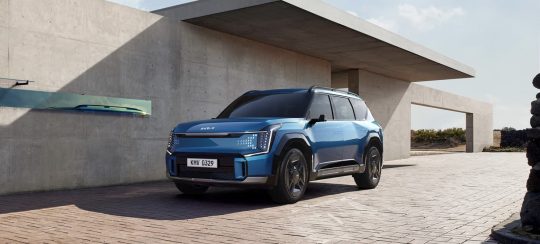
The EV9 is the most expensive car Kia sells in Pakistan and the only one on an 800-volt electrical architecture. One version, the GT-Line, launched on 6 February 2025 and imported as a completely built unit.
The price is PKR 3,86,50,000. That is a limited-time figure announced on 7 September 2026, down PKR 45,50,000 from the launch price of PKR 4,32,00,000 - the largest reduction in Kia's Pakistani electric range. No end date has been published.
Twin motors produce 282.6 kW and 700 Nm through all-wheel drive, taking the car to 100 km/h in 5.3 seconds and on to 200 km/h. The battery is a 99.8 kWh lithium-ion pack giving 505 km of WLTP range.
The 800-volt architecture is what distinguishes it technically. On a 350 kW charger the EV9 goes from 10 to 80 per cent in 24 minutes. The qualification matters: on the 50 kW hardware that is far more common in Pakistan the same charge takes 83 minutes, and a home wallbox at 220V/48A takes 9 hours 45 minutes for 10 to 100 per cent. The headline figure is real but it needs infrastructure that mostly is not here yet.
It is a large car - 5,015 mm long, 1,980 wide and 1,780 tall on a 3,100 mm wheelbase, with 177 mm of ground clearance - laid out as a six-seater with a swivelling second row. Equipment includes a 14-speaker Meridian system, digital side mirrors, a 12-inch head-up display, heated and ventilated first and second row seats, an 18-way powered driver's seat, seven airbags, dual power sunroofs, 21-inch alloys on Continental tyres and 3.6 kW vehicle-to-load both inside and out.
Twin motors, one on each axle, producing a combined 282.6 kW - 141.3 kW each, between 4,000 and 7,800 rpm - and 700 Nm, 350 Nm from each motor between 0 and 3,800 rpm. Drive is permanent all-wheel drive through single-speed reduction gearing. 0-100 km/h takes 5.3 seconds and the top speed is 200 km/h. The battery is a 99.8 kWh lithium-ion pack rated at 318 kW of output, with both a battery saver and a heating system. The architecture runs at 800 volts, which is what allows the very high charging rates: 10 to 80 per cent in 24 minutes on a 350 kW charger drawing up to 310 amps, or 83 minutes on a 50 kW unit at up to 125 amps. On alternating current, a 220V/48A supply with an 11 kW wallbox takes 9 hours 45 minutes from 10 to 100 per cent; the portable in-cable control box at 220V/12A takes 42 hours 35 minutes and should be regarded as an emergency measure only. Drive modes are Normal, Eco, Sport and My Drive, with Snow, Mud and Sand terrain modes. Braking is ABS with electronic stability control, downhill brake control and hill-start assist, with an electric parking brake and auto hold. Kia quotes 33.4 metres from 100 km/h to rest. Tyres are 285/45 R21 Continental PremiumContact on 21-inch alloys, with a temporary mobility kit rather than a spare wheel.
An electric car has no fuel average, so the figures here are consumption and range. Kia publishes 505 km of WLTP range from the 99.8 kWh battery. Unlike the EV5, no NEDC figure is quoted for the EV9, so there is only one number to work with and it is the realistic one. Derived from battery energy over that range, consumption is about 19.8 kWh per 100 km. That is a gross figure against total capacity, so real consumption will be a little higher - which is unsurprising for a 5,015 mm, all-wheel-drive vehicle on 21-inch wheels. In Pakistani summer conditions with air conditioning running continuously, plan on roughly 85 per cent of the WLTP figure - around 430 km on a full charge. Motorway cruising at 120 km/h will reduce it further; electric cars lose range at sustained high speed in a way combustion cars do not. The charging arithmetic matters more than the consumption. At home on a 220V/48A supply, 10 to 100 per cent takes 9 hours 45 minutes, which is an ordinary overnight charge. On the road, the 24-minute figure requires 350 kW hardware that is rare in Pakistan; on a 50 kW charger budget 83 minutes for 10 to 80 per cent. Anyone planning intercity travel in an EV9 should map the chargers before the route.
Open any variant above for its full specification sheet.
Seven airbags, and the complete driver-assistance package - there is only one trim, so nothing is held back for a higher one.
Smart cruise control, lane keeping assist, lane following assist 2.0, forward collision assist 2.0, blind-spot collision avoidance assist, the blind-spot view monitor, rear cross-traffic collision avoidance assist, the surround-view monitor, parking collision avoidance assist forward and reverse, parking distance warning, driver attention warning, high beam assist, manual speed limit assist, a rain sensor, rear occupant alert, automatic child lock on the driver's door and tyre-pressure monitoring.
Braking is ABS with electronic stability control, downhill brake control and hill-start assist, with trailer stability assist, multi-collision braking and an electric parking brake with auto hold. Kia quotes a 100-0 km/h stopping distance of 33.4 metres, which is short for a vehicle of this mass and reflects the 285-section Continental tyres.
The digital side mirrors are worth a note: they replace glass with cameras and interior screens, which improves the view in rain and removes the blind spot a conventional mirror housing creates, but takes acclimatisation and is more expensive to repair after a knock.
Pakistan has no NCAP programme, so the car sold here carries no independent local crash rating.
PKR 3,86,50,000 ex-factory for the GT-Line, the only version sold. This is a limited-time price announced on 7 September 2026, down PKR 45,50,000 from the launch price of PKR 4,32,00,000. No end date has been published, so it may revert.
505 km on the WLTP cycle from a 99.8 kWh battery. In Pakistani summer conditions with air conditioning running, plan on around 430 km.
10 to 80 per cent in 24 minutes on a 350 kW charger, which its 800-volt architecture allows. On the 50 kW chargers more common in Pakistan the same charge takes 83 minutes. At home, a 220V/48A supply with an 11 kW wallbox takes 9 hours 45 minutes for 10 to 100 per cent.
Six, in three rows, with a swivelling second row that can turn to face the third.
282.6 kW and 700 Nm take it to 100 km/h in 5.3 seconds, with a top speed of 200 km/h.
Yes, up to 3.6 kW both from an interior socket and an exterior adaptor, so it can run household appliances from the drive battery.
No. It is imported as a completely built unit.
Kia Pakistan's warranty page publishes 4 years or 100,000 km on the vehicle but does not state a drive-battery term for its electric models, referring owners to the booklet supplied with the car. Ask the dealer to confirm it in writing before buying.
No. It carries a temporary mobility kit. The tyres are 285/45 R21 Continental PremiumContact on 21-inch alloys.
Cameras in place of glass mirrors, feeding screens inside the cabin. They give a better view in rain and remove the blind spot created by a conventional mirror housing, but take getting used to and cost more to replace after damage.